A History of US-Iranian Relations (Part II)
This article delves into the question, "What factors and events in US-Iranian relations over the past four, nearly five, decades have prevented diplomacy from taking hold?"
Part I of this series considered Iran's perspective, tracing the history of US-Iranian relations from the early twentieth century through the severing of diplomatic ties in January 1981. It examined how Iran’s experiences of colonial subjugation by Britain and Russia created a deep nationalist suspicion of foreign interference, how the US-backed coup of Prime Minister Mohammed Mossadegh in 1953 attached the imperialist label to the United States in Iranian political memory, and how the Shah’s autocratic rule, propped up by American support, produced the mass popular uprising that brought Ayatollah Khomeini to power in 1979.
Part I also considered how the Islamic Revolution enshrined anti-Americanism as a founding ideological premise of the new Iranian state, and how the 444-day hostage crisis that followed made the rupture between Washington and Tehran the new norm, formalized by the Algiers Accords of January 1981 [1].
This article picks up where Part I left off. The central question it asks is why every attempt to repair that severing of relations failed, and how those failures produced the conflict taking place today, examined across five sections:
- Section I examines the Iran-Iraq War (1980–1988), the single most consequential event in shaping Iran’s modern strategic worldview.
- Section II traces Iran’s development of a grand strategy of “forward defense” and the construction of a regional proxy network, which became its primary instrument to wield influence across West Asia.
- Section III analyzes the nuclear standoff between the United States and Iran—the defining arena of confrontation over the past two decades—and the collapse of diplomacy it generated.
- Section IV examines the domestic erosion of the Islamic Republic’s legitimacy.
- Section V covers events from the October 7, 2023 attack to the present day, leading into a conclusion examining what, after four decades of failure, might finally be different.
Section I: The Iran-Iraq War and Its Long Shadow (1980–1988)
No event in the history of the Islamic Republic did more to shape its national security worldview than the Iran-Iraq War. To understand Iran’s strategic posture—including the development of its proxy networks, its nuclear program, and its profound distrust of international institutions—one must begin here. The roots of the conflict lay in a longstanding territorial dispute centered primarily on the Shatt al-Arab waterway linking both countries to the Persian Gulf. When Saddam Hussein, the president of Iraq, weighed an invasion of Iran, he was motivated by several overlapping factors: resolving the border dispute on favorable terms, asserting Iraqi regional dominance, and, most urgently, preventing an Islamic revolution in Iraq. Hussein was alarmed due to Ayatollah Khomeini’s public calls to overthrow Saddam Hussein and for Iraq’s Shia majority to resist Iraq's secular Baathist regime led by Hussein [2].
On September 22, 1980, Hussein launched a full-scale invasion of Iran. The war lasted eight years (1980–1988) and unfolded across three broad phases:
- 1980–1982 Phase: Iraqi forces invaded and occupied significant Iranian territory, including the oil-rich province of Khuzestan. Iran halted Iraqi advances by mobilizing a revolutionary fervor that partially offset its initial military disorganization.
- 1982–1986 Phase: The dynamic reversed sharply after Iran recaptured the strategic border city of Khorramshahr in May 1982. Iran subsequently invaded Iraqi territory, with Khomeini declaring that the war would continue until Hussein was toppled [3]. Lacking the conventional military capacity to achieve regime change in Baghdad, Iran became overextended. The war degenerated into a brutal war of attrition with neither side securing a decisive advantage.
- 1986–1988 Phase: International backers resupplied Iraq, tilting the balance of power back in its favor. Following a series of Iraqi counteroffensives pushing Iranian forces back to the prewar border, Khomeini accepted UN Security Council Resolution 598 in July 1988. The resolution mandated an immediate ceasefire, troop withdrawals, and prisoner repatriations. Unhappy with the compromise, Khomeini famously likened accepting the ceasefire to “drinking from a poisoned chalice” [4].
The United States, despite publicly claiming its neutrality in the war, was not neutral. As the war progressed, American policymakers grew increasingly alarmed at the prospect of an Iranian victory. In 1982, as Iranian forces pushed into Iraqi territory, the Reagan Administration issued a presidential directive affirming that the United States “could not afford to allow Iraq to lose the war to Iran” and “would do whatever was necessary to prevent Iraq from losing” [5]. In practice, this entailed sharing satellite and signals intelligence with Iraqi military planners [6]. Even after CIA assessments confirmed that Iraq was systematically deploying chemical weapons against Iranian forces, the collaboration continued [7]. Reports later revealed specifically that American military personnel assisted Iraqi commanders in interpreting intelligence utilized in chemical strikes [8]. This support continued for years, including in 1987 under Operation Earnest Will, where the US Navy escorted Kuwaiti oil tankers through the Gulf, effectively protecting Iraq’s financial backers from Iranian retaliation[9].
Bilateral relations deteriorated to historic lows, punctuated by the downing of Iran Air Flight 655 on July 3, 1988. The USS Vincennes, a guided-missile cruiser operating in the Persian Gulf, shot down the civilian airliner, killing all 290 passengers and crew on board [10]. Although an internal US investigation deemed the shootdown an accident, the Reagan Administration issued no formal apology, and the ship’s captain was subsequently awarded the Legion of Merit upon returning to the United States.
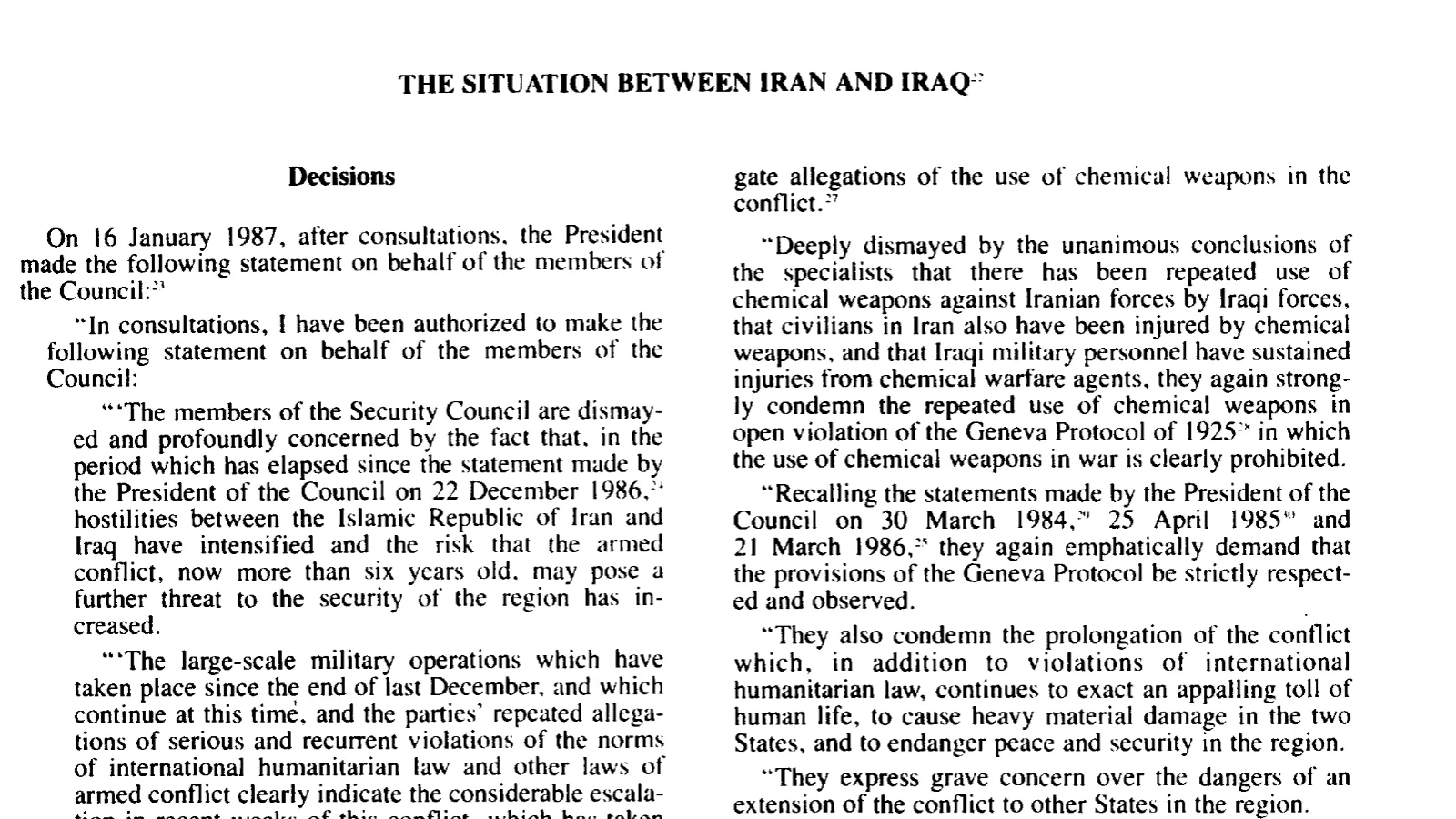
The United Nations’ response further deepened Tehran’s perception of international bias. When Iraq invaded in September 1980, the Security Council called for a ceasefire but refrained from naming Iraq as the aggressor. When Iraq deployed chemical weapons against Iranian troops in violation of the 1925 Geneva Protocol, the Security Council again refused to condemn Iraq, using neutral language to describe the calamities [11].
The Security Council finally condemned the use of chemical weapons in response to an attack on the Kurdish village of Halabja inside Iraq. Still, it failed to acknowledge the aforementioned incidents of their use against Iranian soldiers. And while the ceasefire passed in 1987, it failed to assign responsibility to Iraq for starting the conflict. Tehran interpreted these omissions as evidence of political bias. [12].
The Costs of War
The Iran-Iraq War was among the deadliest conflicts of the late twentieth century, claiming an estimated 200,000 to 600,000 Iranian lives, injuring hundreds of thousands more, devastating major urban centers, and crippling Iran’s economy. However, out of this brutal conflict, Iran experienced a political transformation that would shape its foreign policy outlook for decades to come. As hostilities continued, the Islamic Revolutionary Guard Corps (IRGC) consolidated political authority, marginalizing moderate factions advocating diplomatic engagement. Framing national security as an existential struggle, the IRGC hardened the culture of “sacred resistance,” the premise that Iran operated in an inherently hostile world. It was a premise that would shape the foundation of the new state [13].
Iran survived the war, but learned three lessons that would govern its decision-making from a stance of opposition towards the rest of the world for the next four decades [14]:
- International institutions and legal norms cannot be relied upon when the vital interests of major powers are at stake.
- Conventional military parity with Western-backed adversaries is unattainable, considering that global powers seem committed to arm Iran’s rivals actively.
- And finally, the third and most consequential lesson was that the United States was not simply a rival for regional dominance, but an existential threat, willing to use its power to undermine, and if able, to overthrow the regime.
In response to these three factors, real or perceived, Iran took the stance that defending itself against not only its neighbors but also the United States had become a necessary strategy.
Section II: The Strategy of Forward Defense and the Birth of the Axis of Resistance
Iran’s most consequential asymmetric innovations occurred extraterritorially through the sponsorship of aligned non-state actors, particularly in Lebanon and Iraq. The principal model was Lebanese Hezbollah, established in 1982 during the Israeli invasion of Lebanon. Formed with Iranian operational guidance, training, and funding, Hezbollah orchestrated the 1983 Beirut barracks bombings, killing 241 US Marines and 58 French paratroopers. The bombings were a major factor in the eventual withdrawal of the multinational force. Building upon these operations, Rezaie and Iranian strategic planners formalized the doctrine of “forward defense” [18].
The logic of forward defense was that Iran could best protect itself by maintaining a military and political presence throughout the Middle East, rather than merely protecting its own borders [18]. If Iran’s enemies had to fight proxy groups in Lebanon, Iraq, Syria, and Yemen, the idea was that they would have neither the resources nor the political will to bring the war to Tehran. Developed within a strategic scenario in which it was surrounded by hostile states and was faced with the United States’ vastly superior conventional military capabilities, Iran began to fight the only way it could, unconventionally.
Hezbollah became the cornerstone of this posture, functioning simultaneously as a domestic Lebanese political party and the primary vanguard of Iran’s regional deterrence architecture. The 1983 Beirut bombings prompted the US Department of State to designate Iran as a State Sponsor of Terrorism in 1984, a designation that remains in effect [19].
The episode demonstrated to Iranian strategists that the United States had limited domestic appetite for sustaining casualties in asymmetric conflicts—a vulnerability Tehran sought to leverage.
The first major opening of Iran towards the West occurred under President Hashemi Rafsanjani, elected on July 28, 1989, winning 96% of the vote. Only one of two candidates allowed on the ballot of a possible 97, Rafsanjani took over the presidential seat previously held by Ayatollah Ali Khamenei, who became the Supreme Leader following the death of Ayatollah Khomeini. Rafsanjani and Khamenei were allies during the Islamic Revolution and the Iran-Iraq War, but on foreign policy, their viewpoints diverged, and Rafsanjani used the presidency to promote his own agenda. In 1990, for example, Rafsanjani opened a back-channel negotiation with the United States through the United Nations, offering to secure the release of American hostages held by Hezbollah in Lebanon in exchange for the unfreezing of Iranian assets, which the US accepted in principle but subsequently reneged [20].
The breakdown of negotiations with the US undermined Rafsanjani’s domestic standing and empowered hardline elements within the security establishment, who resumed overseas covert operations, including the 1991 assassination of former Prime Minister Shapour Bakhtiar in Paris [21], the 1992 Mykonos restaurant assassinations of Kurdish leaders in Berlin [22], and the 1996 Khobar Towers bombing in Saudi Arabia [23].
New hope surfaced in 1997, however, with the election victory of the reformist Mohamed Khatami. Running on a platform of political liberalization and engagement with the international community, Khatami won with a stunning 69% of the popular vote, a margin which shocked the conservative establishment inside Iran [24]. Championing a “dialogue” between civilizations, rather than open confrontation with the West, he advocated for a plan that included improving ties with Saudi Arabia and the European Union, while extending an olive branch to the United States [25]. In an interview on CNN with Christiane Amanpour, he even called the United States a great nation and commented that slogans like "'death to America' . . . symbolize a desire to terminate a mode of relations which existed between Iran and the United States [26].” In response to these developments, the Clinton administration was somewhat receptive, easing some sanctions on Iran and acknowledging American responsibility for the 1953 coup [27].
Despite the progress he made, Khatami’s initiatives were systematically undermined by hardliners who controlled the IRGC, the intelligence apparatus, and the judiciary. Conservative elites viewed diplomatic normalization as an ideological and institutional threat to their domestic authority, reinforcing a cycle wherein inadequate American reciprocation justified hardline obstruction.
Containing the "Axis of Evil," Affirming "Forward Defense"
This dynamic resurfaced following the September 11, 2001 terrorist attacks by al-Qaeda. Seeking to overthrow the Taliban—a radical Sunni movement that had seized Kabul in 1996, persecuted Afghan Shia, and murdered eleven Iranian diplomats at the Mazar-e-Sharif consulate in 1998 [28]—the United States found common strategic ground with Tehran. Iran provided intelligence, coordinated with the anti-Taliban Northern Alliance, and facilitated contact between CIA officers and regional commanders [29, 30]. Iranian diplomats played a constructive role at the December 2001 UN Bonn Conference in establishing Afghanistan’s post-Taliban interim government [29]. Despite this unprecedented cooperation, President George W. Bush designated Iran as part of an “Axis of Evil” alongside Iraq and North Korea in his January 2002 State of the Union Address [31]. The designation halted nascent bilateral momentum, though tactical contacts continued [32].
In May 2003, two months after the US invasion of Iraq, Tehran transmitted a comprehensive negotiation proposal via the Swiss Embassy—the so-called “Grand Bargain” memo. The document offered negotiations on Iran’s nuclear program, full transparency regarding al-Qaeda operatives in Iranian custody, and acceptance of a two-state Israeli-Palestinian settlement in exchange for sanctions relief and security guarantees [33]. The Bush Administration declined to engage with the proposal, preferring to pursue a policy of regional containment and regime pressure [34].
Reaching the point of a diplomatic stalemate, relations between the US-Iran did not fundamentally change during the remaining years of the Bush administration. The 2006 Lebanon War, however, did provide a major breakthrough for Iran’s doctrine of forward defense.
Attacking an IDF convoy along the Lebanese-Israeli border on July 12, 2006, Hezbollah killed three IDF soldiers and abducted two others, hoping to use them as bargaining tools for the release of Lebanese prisoners detained in Israel and for the return of the disputed, Israeli-occupied Sheba farms. Israel responded by launching “Operation Change of Direction,” a military operation with the specified goal of removing Hezbollah from the border of Israel.
Section III: The Nuclear Standoff – Diplomacy, Collapse, and Escalation (2002–2020)
Iran’s nuclear program originated during the Pahlavi monarchy under US auspices. In 1957, President Dwight D. Eisenhower launched the Atoms for Peace initiative, providing Tehran with technical expertise, a 5-megawatt research reactor, and enriched uranium fuel [35]. The Shah harbored nuclear ambitions, noting that if neighboring states developed nuclear capabilities, Iranian national interests would dictate doing the same [36]. Halted during the 1979 Revolution, the nuclear program was covertly reactivated during the Iran-Iraq War as strategic planners sought an ultimate deterrent against existential threats [37].
The program operated covertly until August 2002, when the National Council of Resistance of Iran revealed undisclosed nuclear sites: a uranium enrichment facility at Natanz and a heavy-water production plant at Arak [38]. Subsequent IAEA inspections and satellite monitoring confirmed undeclared nuclear activities, placing Iran in breach of its safeguards obligations under the Nuclear Non-Proliferation Treaty (NPT).
Coming shortly before the March 2003 US invasion of Iraq under the justification of eliminating Weapons of Mass Destruction (WMDs), these revelations placed Iran directly in Washington’s strategic crosshairs [39]. Confronted with potential military action, Tehran adopted a dual-track approach: pursuing diplomatic negotiations with Britain, France, and Germany (the E3) while steadily expanding its technical enrichment capabilities [40, 41]. In 2003, Supreme Leader Khamenei condemned the development, stockpiling, and use of nuclear weapons in public speeches [42]. Simultaneously in private discussions, Khamenei insisted that Iran retained an inalienable right to domestic enrichment under the NPT [43].
Some diplomatic progress on Iran’s nuclear program was made in 2003, when in the EU-3 negotiations, a tentative framework halting the enrichment program in exchange for sanctions relief and security guarantees was produced. However, the Bush administration halted this progress, vetoing the framework and declining to join the talks or offer a counterproposal. Up to this point, the United States, under the Bush administration, had proven itself unwilling to negotiate with Iran on its nuclear program.
Obama and the Joint Plan of Action of 2015
A significant shift in attitude towards negotiation with Iran occurred under President Barack Obama, whose administration paired multilateral economic sanctions with covert operations and direct diplomacy. In 2010, the joint US-Israeli Stuxnet cyberattack disabled roughly 1,000 centrifuges at Natanz [44]. Simultaneously, the administration initiated secret bilateral talks in Muscat, Oman, mediated by Sultan Qaboos [45]. These back-channel negotiations accelerated following the 2013 election of President Hassan Rouhani, who campaigned on resolving the nuclear dispute to secure sanctions relief [46]. In July 2015, Iran and the P5+1 (the United States, United Kingdom, France, Russia, China, and Germany, alongside the EU) concluded the Joint Comprehensive Plan of Action (JCPOA) [47].
Under the JCPOA, Iran reduced its enriched uranium stockpile by 98%, capped enrichment purity at 3.67%, dismantled two-thirds of its operational centrifuges, redesigned the Arak heavy-water reactor to eliminate weapons-grade plutonium production, and accepted the IAEA’s Additional Protocol inspection regime. In return, multilateral nuclear-related sanctions were lifted, restoring Iranian access to frozen overseas assets and global oil markets. The JCPOA was intentionally structured as a narrow arms-control agreement; it did not restrict Iran’s ballistic missile development or regional proxy operations.
Despite its diplomatic achievement, the JCPOA faced substantial regional and domestic opposition. Israeli Prime Minister Benjamin Netanyahu denounced the agreement as a strategic error [48], while Saudi Arabia and Gulf partners argued that sanctions relief would finance Iran’s regional proxy networks [49, 50]. Within Iran, hardliners argued that the agreement compromised national sovereignty and made the economy excessively vulnerable to Western compliance [51, 52].
In May 2018, President Donald Trump unilaterally withdrew the United States from the JCPOA, initiating a “Maximum Pressure” campaign consisting of comprehensive extraterritorial sanctions [53]. Between 2018 and 2022, Iran’s economy contracted by 7.3%, per capita income fell by 14%, poverty rose by 11%, and food prices surged by 186% [54]. Meanwhile, Iran remained formally committed to the JCPOA, until evidence emerged that it had stopped implementing its nuclear-related commitments and denied IAEA access to monitor its nuclear facilities in May 2019 [55].
In the fallout of the JCPOA’s breakdown, the Trump administration calculated that they could force Iran to the negotiating table by using its economic influence over the country to inflict pain upon it, and the aforementioned data from 2018 to 2022 bore out this assumption. It was expected that Iran would feel compelled to negotiate and offer more concessions than it had offered in the JCPOA. The standoff escalated throughout 2019 following Washington’s decision to terminate sanctions waivers for international importers of Iranian oil [56]. The move effectively sought to reduce Iranian oil exports to zero, prompting Iran to respond by resuming its high-level uranium enrichment using advanced centrifuges forbidden by the JCPOA. Iran, also, simultaneously unleashed its foreign defense network. In May 2019, it attacked four tankers in UAE waters [57] and in September 2019, it struck the Abqaiq and Khurais oil facilities in Saudi Arabia, temporarily cutting Saudi oil production in half [58]. These attacks represented the most significant challenge to the Carter Doctrine of 1980, which committed the US to defend Persian Gulf energy flows by force.
In January 2020, the Trump administration responded to this new challenge to US dominance in the Persian Gulf by assassinating IRGC Quds Force Commander General Qasem Soleimani. Soleimani was the architect of Iran’s proxy network and its most consequential security official [59]. Since the Iranian Revolution, his assassination was the most significant killing of an Iranian official, prompting Iran to unleash a ballistic missile barrage against the Ain al-Asad American base in Iraq [60].
Subsequent attempts by the Biden Administration (2021-2025) to revive the JCPOA in Vienna stalled [61]. By late 2023, Iran had accumulated stockpiles of uranium enriched to 60% purity [62]. Achieving this purity represented only a short technical step away from the ability to produce weapons-grade equipment. The advancement was accompanied by the operation of centrifuges whose capacity exceeded the stipulations of the JCPOA. The deal was, in effect, dismantled, and the minimalist arms control approach being adhered to, abandoned.
Section IV: The Domestic Erosion of the Islamic Republic (2009–2025)
Even as Iran’s regional position grew more formidable during the 2010s through the development of its proxies in Lebanon, Iraq, Syria, and Yemen, and the advancement of its nuclear program, the Islamic Republic also faced domestic turmoil. These two trends, far from being isolated, were mutually reinforcing. The resources, political capital, and moral authority consumed by the strategy of forward defense contributed directly to the alienation of the population that strategy was ostensibly designed to protect.
The first major rupture Iranian regime's internal credibility came in the summer of 2009 when Mahmoud Ahmadinejad was declared the winner of the June presidential election with a margin of victory over reform candidate Mir Hossein Mousavi that most independent observers deemed implausible [63]. Reinforcing skepticism of the result was also the fact that the announcement of Mousavi’s victory came within hours of the polls closing, before a realistic count could be completed. In the aftermath, the largest mass protests in the history of the Islamic Republic began, with millions demonstrating under the banner of the Green Movement, demanding democratic reform [64]. Millions marched demanding electoral integrity and institutional reform. The state responded with violent crackdowns by the IRGC and Basij, killing dozens and imprisoning political leaders, journalists, and activists. The crackdown permanently damaged the regime’s claim to popular legitimacy.
Facing a loss in domestic credibility, the Islamic Republic has also faced a deteriorating economic situation. Successive rounds of international sanctions, compounded by the IRGC’s stranglehold over key economic sectors, widened income inequality to the detriment of the Iranian middle class [65]. These events preceded maximum pressure, and by the time the Trump administration’s policy took full effect, the social consequences of Iran’s economic situation began to rear its ugly head. Following the re-imposition of US sanctions in 2018, the Iranian rial lost over 96% of its value, inflation hovers at 48.6%, the black market has expanded, and corruption has worsened [66]. Ordinary Iranians have been disproportionately affected by these conditions as IRGC-connected business networks, which had established supply chains specifically to evade sanctions, weathered the storm far better [67]. While beneficial for these networks, this disparity reinforced the perception that the regime’s ideological commitments were extracting a toll that the Iranian people, who had no say in making them, were being forced to pay.
Amid the persisting economic crisis that consumed the nation was the death of 22-year-old Mahsa Amini for the so-called modesty violation of improperly covering her hair. In September 2022, her death in the custody of Tehran’s morality police ignited nationwide protests under the banner “Woman, Life, Freedom” [68], a phrase that captures grievances far exceeding the hijab [69]. Cast in a broader light, the protests were an indictment of the entire governing arrangement of Iran, including its corruption, economic mismanagement, and repression. Demonstrations spread across all 31 provinces, uniting diverse socioeconomic classes, students, and ethnic minorities (including Kurdish and Baloch communities). Unlike previous single-issue protests, the 2022 uprising challenged the ideological and institutional foundations of the clerical regime. State security forces suppressed the demonstrations through lethal force, mass arrests, and executions [68].
The picture painted by demonstrators was validated by economic data, which by 2020 showed that the Iranian middle class, roughly 45% of the population in 2017, had contracted to approximately 30%. The government, which had in the past, grounded its domestic legitimacy in promises of equality and wealth redistribution, was now presiding over a society that had grown significantly poorer and more unequal on its watch. Foreign Minister Mohammad Javad Zarif emphasized this point, saying that “Throughout our history, we have defined our goals in terms of our aspirations without regard for our capabilities” [70]. He was suggesting that Iran’s foreign policy and regional goals were simply unrealistic, resulting in overextension abroad and increased estrangement among its people at home, a combination making the regime more aggressive at home and abroad, yet more brittle.
Section V: The Road to War (2023–2026)
The current chapter in the history of the US-Iranian relationship has been shaped primarily - it seems - by the Gaza War. Hamas’s October 7, 2023 attack on Israel, the deadliest single attack on Jewish people since the Holocaust, resulted in Israel’s most devastating military campaign in Gaza’s history. For Gaza’s civilians, the war brought mass casualties, repeated displacement, the devastation of the built environment, and a humanitarian crisis marked by severe shortages of food, clean water, medical care, and shelter.
The was has inflicted a series of blows on the Axis of Resistance from which it has not recovered since Operation Epic Fury began. The foremost player from the Axis, is Hamas, a Palestinian Sunni Islamist political and militant movement that has governed Gaza since 2007. Prior to the attack, Iran had spent years cultivating Hamas as a component of its forward defense strategy, making it a part of the Axis of Resistance. Iran provided weapons, training, and financing that built the military capability Hamas recently demonstrated during the October 7th attack [71]. While the attack demonstrated Hamas’s, and more broadly, Iran’s proxy network’s abilities to inflict devastating attacks on its enemies, the war that followed was catastrophic for the Palestinian civilians living in Gaza and strategically disastrous for Iran.
Israel’s campaign in Gaza was not isolated to the small enclave, but also included strikes on Hezbollah in Lebanon, including on September 17-18, 2024, when thousands of hand-held pagers and walkie-talkies held by Hezbollah members simultaneously exploded [72]. On September 27, Israeli strikes killed Hassan Nasrallah, the leader of the organization for thirty-two years, and later, killed the bulk of Hezbollah’s senior military command structure [73]. The attacks fell with a speed and precision that caught Iran off guard and called into question decades of strategic investment in the organization that became the centerpiece of its forward defense.
Tensions mounted with a direct confrontation between Iran and Israel escalating in the April 2024 Israeli airstrike on the Iranian consular annex in Damascus [74]. Iran responded on April 13 with Operation True Promise, launching over 300 ballistic missiles, cruise missiles, and drones directly at Israeli territory [75, 76]. The attack substantively changed the dynamic between the two nations, representing the first direct Iranian attack on Israeli territory. Although the vast majority of the missile strikes were intercepted by Israeli, American, British, French, and Jordanian air defenses, the exchange ended decades of indirect proxy warfare. IRGC Commander Hossein Salami articulated a new operational doctrine: “If you hit us, we will hit back from our own soil” [77], a significant departure from Iran’s decades-long preference for deniable proxy action.
Hostilities escalated further on June 12, 2025, into the Twelve-Day War [78]. Following preemptive Israeli strikes under Operation Rising Lion, the United States directly intervened on June 22 in Operation Midnight Hammer, striking Iranian enrichment facilities at Fordow, Natanz, and Isfahan [79]. The operation destroyed or disabled an estimated 22,000 installed centrifuges, Iran’s entire enrichment infrastructure, and President Trump declared that Iran’s nuclear program had been "obliterated" [80]. While analysis suggested that Iran’s nuclear facilities were damaged, the claim that its nuclear program was destroyed entirely is not conclusive [81]. A ceasefire took effect on June 24, 2025, leaving core security questions such as Iran’s nuclear program and the status of its military apparatus unresolved.
In Iran, in January of 2026, against a backdrop of political uncertainty after President Ebrahim Raisi’s 2024 death and severe economic deterioration, nationwide protests in Iran began again, resulting in widespread crackdowns, with over 6,000 deaths reported in late January 2026 [82]. When American officials publicly expressed sympathy for the demonstrators, Tehran accused Washington of intervening in internal affairs, accentuating the bilateral tensions.
The United States had been planning an attack on Iran, launching it on February 28, 2026, alongside Israel in Operation Epic Fury. At a press conference shortly after the attack, President Trump outlined four operational objectives:
- Destroying Iran’s ballistic missile capabilities.
- Neutralizing the Iranian navy.
- Preventing Iran from acquiring a nuclear weapon.
- Severing Iran’s command, financing, and supply lines to regional proxy networks [83].
Within days, strikes had hit over 2,000 targets inside Iran, including one that killed Ayatollah Khamenei. In retaliation, Iran launched strikes against Israel, Bahrain, Kuwait, Qatar, Saudi Arabia, the UAE, Jordan, and Oman, prompting them to consider direct military involvement against Iran [84], a sign that the conflict could quickly spiral out of control.
Conclusion
References & Notes
¹ “Text of Agreement Between Iran and the United States to Resolve the Hostage Situation,” New York Times, January 20, 1981, https://www.nytimes.com/1981/01/20/world/text-of-agreement-between-iran-and-the-us-to-resolve-the-hostage-situation.html.
² Will D. Swearingen, “Geopolitical Origins of the Iran-Iraq War,” Geographical Review 78, no. 4 (October 1988): 405, https://doi.org/10.2307/215091.
³ “Iranian Says War Will Continue Until Saddam Hussein Is Toppled,” Washington Post, May 27, 1982, https://www.washingtonpost.com/archive/politics/1982/05/27/iranian-says-war-will-continue-until-saddam-hussein-is-toppled/b7a6ef42-4428-4649-89d3-a8e16ef174fc/.
⁴ Vali Nasr, Iran’s Grand Strategy: A Political History (Princeton: Princeton University Press, 2025), 79, https://press.princeton.edu/books/hardcover/9780691268927/irans-grand-strategy.
⁵ Maryam Javan Shahraki, “Extreme Securitization: U.S. Foreign Policy and the Iran-Iraq War (1980–1988),” Iranian Review of Foreign Affairs 3, no. 4 (2013): 61, https://ciaotest.cc.columbia.edu/journals/irfa/v3i4/f_0028358_23067.pdf.
⁶ Bruce Riedel, “Lessons from America’s First Conflict with Iran,” Brookings Institution, May 22, 2013, https://www.brookings.edu/articles/lessons-from-americas-first-war-with-iran/.
⁷ Central Intelligence Agency, “Report on the Use of Chemical Weapons During the Iran-Iraq War,” intelligence report, February 1989, released September 4, 1990, accessed June 8, 2026, https://gulflink.osd.mil/declassdocs/cia/19960417/cia_62690_62671_01.html.
⁸ Patrick E. Tyler, “Officers Say U.S. Aided Iraq in War Despite Use of Gas,” New York Times, August 18, 2002, https://www.nytimes.com/2002/08/18/world/officers-say-us-aided-iraq-in-war-despite-use-of-gas.html.
⁹ Richard A. Mobley, “Deterrence Without Escalation: Fresh Insights into U.S. Decisionmaking During Operation Earnest Will,” Joint Force Quarterly 106 (3rd Quarter 2022): 71–81, https://ndupress.ndu.edu/Portals/68/Documents/jfq/jfq-106/jfq-106_71-81_Mobley.pdf.
¹⁰ Ronald Reagan, “Statement on the Destruction of an Iranian Jetliner by the United States Navy Over the Persian Gulf,” July 3, 1988, Ronald Reagan Presidential Library & Museum, https://www.reaganlibrary.gov/archives/speech/statement-destruction-iranian-jetliner-united-states-navy-over-persian-gulf.
¹¹ UN Security Council, Resolution 612 (1988), S/RES/612 (1988), May 9, 1988, https://digitallibrary.un.org/record/161154.
¹² United Nations Security Council, Resolution 598 (1987), S/RES/598 (20 July 1987), United Nations Digital Library, https://digitallibrary.un.org/record/137345.
¹³ Annie Tracy Samuel, “Perceptions and Narratives of Security: The Iranian Revolutionary Guards Corps and the Iran-Iraq War,” Discussion Paper 2012-06 (Cambridge, MA: Belfer Center for Science and International Affairs, Harvard Kennedy School, May 2012), 1, https://www.belfercenter.org/sites/default/files/pantheon_files/files/publication/samuel_perceptions.pdf.
¹⁴ Nasr, Iran’s Grand Strategy, 81, https://press.princeton.edu/books/hardcover/9780691268927/irans-grand-strategy.
¹⁵ Nasr, Iran’s Grand Strategy, 86, https://press.princeton.edu/books/hardcover/9780691268927/irans-grand-strategy.
¹⁶ Saskia M. Gieling, “Iraq vii. Iran-Iraq War,” Encyclopaedia Iranica, published December 15, 2006, last updated April 11, 2012, https://www.iranicaonline.org/articles/iraq-vii-iran-iraq-war/.
¹⁷ Samuel J. Cox, “H-Gram 018: 30th Anniversary of Operation Praying Mantis,” Naval History and Heritage Command, April 13, 2018, https://www.history.navy.mil/about-us/leadership/director/directors-corner/h-grams/h-gram-018.html.
¹⁸ Hamidreza Azizi, The Concept of “Forward Defence”: How Has the Syrian Crisis Shaped the Evolution of Iran’s Military Strategy?, Syria Transition Challenges Project Research Paper (Geneva: Geneva Centre for Security Policy, February 2021), 5, https://dam.gcsp.ch/files/doc/iran-forward-defence-strategy-en.
¹⁹ “The Reagan Administration and Lebanon, 1981–1984,” Office of the Historian, U.S. Department of State, accessed August 4, 2026, https://history.state.gov/milestones/1981-1988/lebanon.
²⁰ Nasr, Iran’s Grand Strategy, 147, https://press.princeton.edu/books/hardcover/9780691268927/irans-grand-strategy.
²¹ Dan Geist, “‘A Darker Horizon’: The Assassination of Shapour Bakhtiar,” Tehran Bureau, Frontline (PBS), August 6, 2011, https://www.pbs.org/wgbh/pages/frontline/tehranbureau/2011/08/a-darker-horizon-the-assassination-of-shapour-bakhtiar.html.
²² Iran Human Rights Documentation Center, Murder at Mykonos: Anatomy of a Political Assassination (New Haven, CT: Iran Human Rights Documentation Center, February 3, 2011), https://iranhrdc.org/murder-at-mykonos-anatomy-of-a-political-assassination/.
²³ Michael Battles, “25 Years Later: Remembering Khobar Towers Bombing,” National Guard, June 25, 2021, https://www.nationalguard.mil/News/Overseas-Operations/Article/2671211/25-years-later-remembering-khobar-towers-bombing/.
²⁴ “Moderate Clinches Victory in Iran Presidential Election,” CNN, May 24, 1997, https://www.cnn.com/WORLD/9705/24/iran.elex/.
²⁵ Shaul Bakhash, “Iran’s Remarkable Election,” Journal of Democracy 9, no. 1 (1998): 80–94, https://muse.jhu.edu/article/16874.
²⁶ “Transcript of Interview with Iranian President Mohammad Khatami,” CNN, January 7, 1998, https://www.cnn.com/WORLD/9801/07/iran/interview.html.
²⁷ Bruce Riedel, “Iran Primer: The Clinton Administration,” Tehran Bureau, Frontline, PBS, November 2010, https://www.pbs.org/wgbh/pages/frontline/tehranbureau/2010/11/iran-primer-the-clinton-administration.html.
²⁸ Human Rights Watch, “The Massacre in Mazar-i Sharif,” Human Rights Watch Report 10, no. 7 (November 1998), https://www.hrw.org/legacy/reports98/afghan/Afrepor0.htm.
²⁹ Mark Fields and Ramsha Ahmed, “A Review of the 2001 Bonn Conference and Application to the Road Ahead in Afghanistan,” Strategic Perspectives, no. 8 (Washington, DC: National Defense University Press, November 2011), https://ciaotest.cc.columbia.edu/wps/inss/0023642/f_0023642_19350.pdf.
³⁰ Erfan Fard, “Iran and the Taliban,” BESA Center Perspectives Paper, no. 2,147 (September 6, 2021), https://besacenter.org/iran-and-the-taliban/.
³¹ George W. Bush, “President Delivers State of the Union Address” (speech, United States Capitol, Washington, DC, January 29, 2002), White House Archives, https://georgewbush-whitehouse.archives.gov/news/releases/2002/01/20020129-11.html.
³² James Dobbins, “Negotiating with Iran: Reflections from Personal Experience,” The Washington Quarterly 33, no. 1 (2010): 156, https://doi.org/10.1080/01636600903424833.
³³ “Text of Iranian Roadmap Proposal,” fax to U.S. State Department via Swiss Embassy, Tehran, 2003, published by The New York Times, April 29, 2007, https://www.nytimes.com/packages/pdf/opinion/20070429_iran-memo-expurgated.pdf.
³⁴ Mehran Kamrava, “The United States and Iran: A Dangerous but Contained Rivalry,” Middle East Institute, March 1, 2008, https://mei.edu/publication/united-states-and-iran-dangerous-contained-rivalry/.
³⁵ Katherine Malus, “From ‘Atoms for Peace’ to ‘JCPOA’: History of Iranian Nuclear Development,” K=1 Project, September 9, 2018, https://k1project.columbia.edu/content/atoms-peace-jcpoa-history-iranian-nuclear-development.
³⁶ Nasr, Iran’s Grand Strategy, 231, https://press.princeton.edu/books/hardcover/9780691268927/irans-grand-strategy.
³⁷ Institute for Science and International Security, “Iran,” Nuclear Weapons Programs Worldwide: An Historical Overview, accessed July 6, 2026, https://isis-online.org/nuclear-weapons-programs/iran.
³⁸ David Albright and Corey Hinderstein, “The Iranian Gas Centrifuge Uranium Enrichment Plant at Natanz: Drawing from Commercial Satellite,” Institute for Science and International Security, March 14, 2003, https://isis-online.org/publications/iran/natanz03_02.html.
³⁹ Iraq Liberation Act of 1998, H.R. 4655, 105th Cong. (1998), https://www.congress.gov/bill/105th-congress/house-bill/4655/text.
⁴⁰ Kamila Kwapińska and Richard G. Whitman, “The E3,” UK in a Changing Europe, October 30, 2023, https://ukandeu.ac.uk/explainers/the-e3/.
⁴¹ CNN, “Report: Iran Has ‘Extremely Advanced’ Nuclear Program,” March 9, 2003, https://www.cnn.com/2003/WORLD/meast/03/09/iran.nuclear/.
⁴² Khosro Sayeh Isfahani, “The Nuclear Fatwa That Wasn’t—How Iran Sold the World a False Narrative,” Atlantic Council, May 9, 2024, https://www.atlanticcouncil.org/blogs/iransource/iran-nuclear-weapons-fatwa-khamenei/.
⁴³ Nasr, Iran’s Grand Strategy, 236, https://press.princeton.edu/books/hardcover/9780691268927/irans-grand-strategy.
⁴⁴ David E. Sanger, “Obama Order Sped Up Wave of Cyberattacks Against Iran,” New York Times, June 1, 2012, https://www.nytimes.com/2012/06/01/world/middleeast/obama-ordered-wave-of-cyberattacks-against-iran.html.
⁴⁵ Jonathan Schanzer and Nicole Salter, “Oman in the Middle: Muscat’s Balancing Act Between Iran and America,” Foundation for Defense of Democracies, May 9, 2019, https://www.fdd.org/analysis/2019/05/09/oman-in-the-middle/.
⁴⁶ Muhammad Sahimi, “What’s in Store for President-Elect Hassan Rouhani?,” Foreign Policy Association, July 12, 2013, https://fpa.org/whats-in-store-for-president-elect-hassan-rouhani/.
⁴⁷ U.S. Department of State, “Joint Comprehensive Plan of Action,” archived January 20, 2017, https://2009-2017.state.gov/e/eb/tfs/spi/iran/jcpoa/.
⁴⁸ “C4. Israeli PM Benjamin Netanyahu, Condemnation of the Joint Comprehensive Plan of Action, Times of Israel, 14 July 2015 (Excerpts),” Documents and Source Material, Journal of Palestine Studies, Institute for Palestine Studies, https://www.palestine-studies.org/en/node/195959.
⁴⁹ Vivian Nereim, “Saudi Arabia Opposed Obama’s Deal With Iran. It Supports Trump’s. Why?,” New York Times, April 20, 2025, https://www.nytimes.com/2025/04/20/world/middleeast/gulf-saudi-support-trump-iran-nuclear-deal.html.
⁵⁰ Joyce Karam, “UAE, Saudi Arabia and Bahrain Welcome Trump’s Exit from Iran Nuclear Deal,” The National, May 9, 2018, https://www.thenationalnews.com/world/mena/uae-saudi-arabia-and-bahrain-welcome-trump-s-exit-from-iran-nuclear-deal-1.728557.
⁵¹ Sadegh Zibakalam, “Why Iran’s Hardliners Fear a Deal,” Politico Magazine, March 25, 2015, https://www.politico.com/magazine/story/2015/03/iran-nuclear-deal-116296/.
⁵² Ahmad Majidyar, “Hardliners Accuse Europe of ‘Betraying’ Iran on Nuclear Deal,” Middle East Institute, November 3, 2017, https://mei.edu/publication/hardliners-accuse-europe-betraying-iran-nuclear-deal/.
⁵³ The White House, “President Donald J. Trump Is Cutting Off Funds the Iranian Regime Uses to Support Its Destructive Activities Around the World,” fact sheet, May 8, 2019, https://trumpwhitehouse.archives.gov/briefings-statements/president-donald-j-trump-cutting-off-funds-iranian-regime-uses-support-destructive-activities-around-world/.
⁵⁴ Nasr, Iran’s Grand Strategy, 247–248, https://press.princeton.edu/books/hardcover/9780691268927/irans-grand-strategy.
⁵⁵ International Atomic Energy Agency, Verification and Monitoring in the Islamic Republic of Iran in Light of United Nations Security Council Resolution 2231 (2015), Report by the Director General, GOV/2025/24, May 31, 2025, https://www.iaea.org/sites/default/files/25/06/gov2025-24.pdf.
⁵⁶ Tom DiChristopher, “Trump Will End Iran Oil Waivers, Trying to Drive Its Exports to Zero,” CNBC, April 22, 2019, https://www.cnbc.com/2019/04/22/trump-expected-to-end-iran-oil-waivers-try-to-drive-exports-to-zero.html.
⁵⁷ Nada Altaher and Ben Westcott, “Four Ships Targeted in Mystery ‘Sabotage Attack,’ Says UAE,” CNN, May 13, 2019, https://www.cnn.com/2019/05/12/middleeast/uae-cargo-ship-sabotage-intl/index.html.
⁵⁸ David Reid, “Saudi Aramco Reveals Attack Damage at Oil Production Plants,” CNBC, September 20, 2019 (updated September 21, 2019), https://www.cnbc.com/2019/09/20/oil-drone-attack-damage-revealed-at-saudi-aramco-facility.html.
⁵⁹ “Qasem Soleimani: US Kills Top Iranian General in Baghdad Air Strike,” BBC News, January 3, 2020, https://www.bbc.com/news/world-middle-east-50979463.
⁶⁰ “Iran Launches Missile Attacks on US Facilities in Iraq,” Al Jazeera, January 8, 2020, https://www.aljazeera.com/news/2020/1/8/iran-launches-missile-attacks-on-us-facilities-in-iraq.
⁶¹ Sina Toossi, “Biden Had a Chance to Undo Trump’s Mistakes. He Dropped the Ball.,” Responsible Statecraft, May 8, 2024, https://responsiblestatecraft.org/iran-nuclear-deal-2668189539/.
⁶² “Iran Resumes Pace of 60% Uranium Enrichment, IAEA Says,” Agence France-Presse, VOA News, December 26, 2023, https://www.voanews.com/a/iran-resumes-pace-of-60-uranium-enrichment-iaea-says-/7413491.html.
⁶³ Iran’s 2009 Presidential Elections, CRS Report R40653 (Washington, DC: Congressional Research Service, July 6, 2009), https://www.everycrsreport.com/reports/R40653.html.
⁶⁴ Abbas Varij Kazemi, “Appropriating the Past: The Green Movement in Iran,” Global Dialogue, April 28, 2013, https://globaldialogue.isa-sociology.org/articles/appropriating-the-past-the-green-movement-in-iran.
⁶⁵ Yannick Schwarz, “Economic Inequality in the Islamic Republic of Iran,” London School of Economics, February 12, 2018, https://blogs.lse.ac.uk/researchingsociology/2018/02/12/economic-inequality-in-the-islamic-republic-of-iran/.
⁶⁶ Surabhi Singhal and Yuvika Gahlowt, “The Iranian Currency Crisis: Sanctions, Structural Weakness, and the Collapse of the Rial,” International Journal of Recent Trends in Multidisciplinary Research 6, no. 3 (May–June 2026): 46–49, https://www.ijrtmr.com/archiver/archives/the_iranian_currency_crisis_sanctions_structural_weakness_and_the_collapse_of_the_rial.pdf.
⁶⁷ Financial Crimes Enforcement Network (FinCEN), FIN-2026-Alert002, “FinCEN Alert on the Use of Front Companies, Financial Facilitators, and Digital Asset Infrastructure by Iran’s Islamic Revolutionary Guard Corps to Evade Sanctions and Launder Proceeds,” U.S. Department of the Treasury, May 11, 2026, https://www.fincen.gov/system/files/2026-05/FinCEN-Alert-IRGC.pdf.
⁶⁸ Lipika Pelham, “Iran Crackdown on Protests Amounts to Crimes Against Humanity, UN Says,” BBC News, March 8, 2024, https://www.bbc.com/news/world-middle-east-68511112.
⁶⁹ Homa Bazafkan, “‘Women, Life, Freedom’ a New Revolutionary Era in Iran,” Vienna Institute for International Dialogue and Cooperation, 2022, https://www.vidc.org/en/detail/women-life-freedom-a-new-revolutionary-era-in-iran.
⁷⁰ Nasr, Iran’s Grand Strategy, 274, https://press.princeton.edu/books/hardcover/9780691268927/irans-grand-strategy.
⁷¹ Brian Monroe, “Unraveling a Complex Web: A Primer on Hamas Funding Sources, Iranian Support, Global Connections and Compliance Concerns, Considerations,” Association of Certified Financial Crime Specialists, October 26, 2023, https://www.acfcs.org/unraveling-a-complex-web-a-primer-on-hamas-funding-sources-iranian-support-global-connections-and-compliance-concerns-considerations.
⁷² Matt Murphy and Joe Tidy, “What We Know About the Hezbollah Pager Explosions,” BBC News, September 18, 2024, https://www.bbc.com/news/articles/cz04m913m49o.
⁷³ Mick Krever, Sarah El Sirgany, Eyad Kourdi, Mostafa Salem, and Jeremy Diamond, “Israel Killed Hezbollah Leader Hassan Nasrallah in Beirut Strike, Group Confirms,” CNN, September 28, 2024, https://www.cnn.com/2024/09/28/middleeast/hezbollah-nasrallah-killed-israel-strikes-intl.
⁷⁴ “Israel Strikes Iran Consulate in Syria’s Capital Damascus: What We Know,” Al Jazeera, April 2, 2024, https://www.aljazeera.com/news/2024/4/2/attack-on-iran-consulate-in-damascus-what-do-we-know.
⁷⁵ Jeremy Diamond, Hamdi Alkhshali, Nectar Gan, Adam Pourahmadi, Tamar Michaelis, and Andrew Raine, “Iran Launches Unprecedented Retaliatory Strikes on Israel in Major Escalation of Widening Conflict,” CNN, April 13, 2024, https://www.cnn.com/2024/04/13/middleeast/iran-drones-attack-israel-intl-latam.
⁷⁶ Stuart Winer, “Report: Gulf States, Including Saudi Arabia, Provided Intelligence on Iran Attack,” Times of Israel, April 15, 2024, https://www.timesofisrael.com/report-gulf-states-including-saudi-arabia-provided-intelligence-on-iran-attack/.
⁷⁷ Nasr, Iran’s Grand Strategy, 219, https://press.princeton.edu/books/hardcover/9780691268927/irans-grand-strategy.
⁷⁸ “Q&A | Twelve Days That Shook the Region: Inside the Iran-Israel War,” ACLED, July 4, 2025, https://acleddata.com/qa/qa-twelve-days-shook-region-inside-iran-israel-war.
⁷⁹ Congressional Research Service, U.S. Strikes on Nuclear Sites in Iran, CRS Report IN12571 (Washington, DC: Congressional Research Service, June 23, 2025), https://www.congress.gov/crs_external_products/IN/PDF/IN12571/IN12571.1.pdf.
⁸⁰ The White House, “Iran’s Nuclear Facilities Have Been Obliterated — and Suggestions Otherwise Are Fake News,” June 25, 2025, https://www.whitehouse.gov/releases/2025/06/irans-nuclear-facilities-have-been-obliterated-and-suggestions-otherwise-are-fake-news/.
⁸¹ Joseph Rodgers, Heather Williams, and Joseph S. Bermudez Jr., “Damage to Iran’s Nuclear Program—Can It Rebuild?,” Center for Strategic and International Studies, August 6, 2025, https://www.csis.org/analysis/damage-irans-nuclear-program-can-it-rebuild.
⁸² The Associated Press, “At Least 6,126 People Killed in Iran’s Crackdown on Nationwide Protests, Activists Say,” NPR, January 27, 2026, https://www.npr.org/2026/01/27/nx-s1-5689793/6-126-iran-crackdown-protests-death-toll.
⁸³ “Watch: Trump Outlines Objectives for Ongoing Military Operation in Iran,” video, BBC News, March 2, 2026, https://www.bbc.com/news/videos/cqxdy0xqrr8o.
⁸⁴ Patrick Wintour, “Gulf states on verge of acting against Iran over ‘reckless’ strikes across region,” The Guardian, March 2, 2026, https://www.theguardian.com/world/2026/mar/02/gulf-states-iran-strikes-response.
⁸⁵ Institute for the Study of War, “Iran Update, Special Report, April 8, 2026,” April 8, 2026, https://understandingwar.org/research/middle-east/iran-update-special-report-april-8-2026/.
⁸⁶ Lynsey Chutel and Pranav Baskar, “What to Know About Israel’s Strikes on Lebanon,” New York Times, April 9, 2026, https://www.nytimes.com/2026/04/09/world/middleeast/what-to-know-israel-strikes-lebanon.html.
⁸⁷ Munir Ahmed, E. Eduardo Castillo, Ben Finley, and Collin Binkley, “Historic U.S. and Iran Negotiations in Pakistan End Without Agreement,” Associated Press via PBS NewsHour, April 11, 2026, https://www.pbs.org/newshour/world/historic-u-s-and-iran-negotiations-in-pakistan-end-without-agreement.
⁸⁸ Munir Ahmed, Samy Magdy, and Darlene Superville, “Trump Says Deal with Iran, Including Opening Strait of Hormuz, Is ‘Largely Negotiated,’” Associated Press via PBS NewsHour, May 23, 2026, https://www.pbs.org/newshour/world/trump-says-deal-with-iran-including-opening-strait-of-hormuz-is-largely-negotiated.
⁸⁹ NPR Staff, “Read the Full Text of Trump’s Preliminary U.S.-Iran Agreement to End the War,” NPR, June 18, 2026, https://www.npr.org/2026/06/18/nx-s1-5863027/us-iran-trump-memorandum-of-understanding-full-text.
⁹⁰ Duarte Dias, “U.S.-Iran Latest: Attacks Continue Over Control of Strait of Hormuz as Tehran Calls Diplomacy ‘Futile,’” CBS News, updated July 13, 2026, https://www.cbsnews.com/live-updates/us-iran-war-trump-ceasefire-attacks-strait-of-hormuz/.
⁹¹ “Bessent Says There May Be Deal Tuesday or Wednesday to Open Strait of Hormuz with ‘Freedom of Movement,’” CNBC, August 4, 2026, https://www.cnbc.com/2026/08/04/bessent-says-there-may-be-deal-tuesday-or-wednesday-to-open-strait-of-hormuz-with-freedom-of-movement.html.